Τῷ οὖν τόξῳ ὂνομα βίος, ἒργον δέ θάνατος. An essay on «The Death of Ivan Ilyich» by Leo Tolstoy
An essay about Leo Tolstoy’s «The Death of Ivan Ilyich», published on 10.6.2025 by the electronic magazine «The Montréal Review» run by Professor Tsoncho Tsonchev of the McGill University, Canada.
AN ESSAY ON “THE DEATH OF IVAN ILYICH” BY LEO TOLSTOY
ByEleftherios Makedonas
***
The Montréal Review, June 2025
A human being has died, coming across that extraordinarily important fact, having gone through the typical path – longer or shorter but, in any case, always typical, for sure – that an average human being follows in life and yet, nothing around his now lifeless body alludes to the terrible event that has just taken place. The rest of the world, apart from humans, grinds on – apathetic – along its ceaseless course towards its always elusive meaning, characteristically indifferent to such self-evident – and, for that reason, trivial – facts which, when seen objectively enough, conform to the overall material and energetic equilibrium of the system and hence leave its intrinsic order absolutely undisturbed.
Especially humans, however, manifest their peculiar, human indifference, which is not exactly the indifference, literally speaking, of the universe but rather a tinted one, a semantically and ‘ethically’ charged one, so typical of the human being. Animals are truly indifferent to death, as they are also to life. To them, life and death do not constitute two distinct and mutually antithetical phenomena. The lack of ‘consciousness’ in the human sense of the term – that peculiar entity which perceives itself as separate from the world and lives, struggles and dies in constant conflict with the rest of humanity and the world – is the factor that saves the animals from the fear of life and death. The animal does not conserve within any pre-conceived image – image of itself, of others, of life and death – it does not have ideas, and hence, it does not have thought: “Animals, even the most clever ones, lack this ability; hence they have no ideas other than perceptual ones, and accordingly, they know only that which is immediately present; they live only in the present” (Schopenhauer 2005:70).
The animal lives in the uninterrupted continuum that is the world, without any consciousness of itself as something distinct, without distancing itself even for a moment from the Whole, of which it constitutes an intrinsic component, even though it may not be aware of it. Man, on the contrary, has the capacity to form ideas, and these ideas tend to appear in pairs of opposing poles, hence the dual – and therefore conflictual – nature of human thought and of the human being itself: “But man of the dualistic conception is opposite to archaic man in that there is no longer any intimacy1 between him and this world. This world is in fact immanent to him but this is insofar as he is no longer characterized by intimacy, insofar as he is defined by things, and is himself a thing, being a distinctly separate individual” (Bataille 1992:74).
Ivan Ilyich died completely severed from anything and anybody. At least, until a few moments before his death, this was his own sense: one of absolute loneliness, fear, utter separation, and pain. And just a few moments before his death, he came to conceive in its monstrous dimensions the fact that he didn’t mean anything to anybody, that all the bastions, all the bulwarks he had striven to erect as a means for recovering his lost intimacy with the world, for putting down roots and grasping at life however he could, for creating constants and certainties that would render him truly safe and immune to the worm of fear, were all made of the intangible substance of human illusion.
He strived to build a family, like most people do. He followed all the precepts of tradition and social norms. He believed that in his family he would find the love, recognition, and solace he needed to face life’s adversities. However, during his protracted and excruciating descent into the realm of death, he would come terrified to the awareness that it was precisely his family that had been his most bitter enemy. His wife and children had always seen him solely as a necessary evil, a source of money, and a condition sine qua non for the confirmation of their own social persona and vanity.
Ivan Ilyich lies dead and Praskovya Fedorovna – the one who, mere moments ago, had been his ‘wife’ – still sees in him, even in death, an opportunity to further improve her financial position.
Peter Ivanovich sighed and waited for her to finish blowing her nose. When she had done so he said, “Believe me . . . ” and she again began talking and brought out what was evidently her chief concern with him — namely, to question him as to how she could obtain a grant of money from the government on the occasion of her husband’s death (Tolstoy 1917:7).
Of course, Ivan Ilyich was not exempt from responsibility for this development in his life. He fell into the trap of marriage himself, lightly, without giving it too much thought – much like the majority of people do – on the grounds of those immutable, frivolous human criteria of the pursuit of pleasure and the advancement, at any rate, of the self, the me: “He was swayed by both these considerations: the marriage gave him personal satisfaction, and at the same time it was considered the right thing by the most highly placed of his associates. So Ivan Ilych got married” (Tolstoy 1917:12). Because the nucleus of the ego, which is, by definition, separated from the cosmic immanence – the self – is precisely this: an incessant, insatiable pursuit of the pleasurable, the more and, in any case, of what is socially acceptable. And what is socially acceptable is nothing more than the projection onto the outside of that psychological mechanism that we call the ego.
The individual who lives his life in the social mode for his own security, κοινωφελῶς φιλοψυχῶν, ‘attached to life,’ in a socially useful manner, who has found that the freedom of being a slave in life is secure for the man who knows how τοῖς κρατοῦσιν εἰκαθεῖν, ‘to assimilate himself to those who hold power,’ and who has adapted to the social form, is jealous of that form precisely because of the weakness2 through which he placed his trust in it; he is jealous in the same way that the creditor is jealous of his promissory note, who, in accepting it and entrusting his belongings to it, depends for his life on that piece of paper. For each is attached – the latter to the paper, the former to the social form – like a shipwreck victim to a saving plank, not out of love for the plank but for his own salvation. Thus do men, who have accepted society’s promissory note, hold it with their benumbed fingers—or with the firmness of their principles—and hence derives their angry glance toward the opinion of others, the στάσις, ‘firmness,’ of every faith that might ἐπεγείρῃ στάσιν τινά, ‘stir up rebellion,’ toward every deed that might become seditious (Michelstaedter 2004:118).
Human society has been constructed by humans not the other way around. Humans create their society in their own image. Society is deeply immoral and degenerate, precisely because human beings, severed from the cosmic continuum, are themselves deeply immoral and degenerate. And, once they have constructed this degenerate society, they find themselves trapped within that very grid of relationships they initially projected onto the outside world. Society is nothing more than the externalized replica of the human animal’s inner psychological structure. And then, humans strive to break free of this reflection, struggling and fighting, but of course, in vain. For, in essence, they are battling none other than themselves – worse still, with their own shadow.
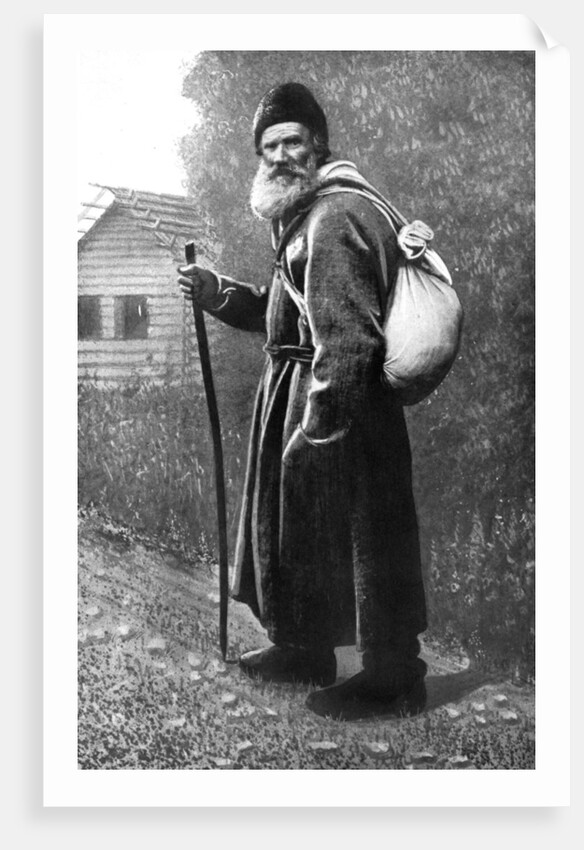
Lev Nikolayevich Tolstoy (1828 – 1910)
Driven exclusively by the projections of their own thought, seeking endlessly pleasure, delight and security, we are in fact the ones who create our own traps – both inwardly and outwardly – only to realize, ex post, that we are now imprisoned in new prisons, which we stubbornly continue to regard as externally imposed, when in fact they are solely the product of our own imagination and craft. We simply harvest what we have projected onto the outside world. The aggrandizement of our own ego, however, is inevitably doomed to eternally clash with the aggrandizement of the egos of all others. The result cannot be other than a perpetual conflict between one’s own self and all other selves.
But one day his wife began upbraiding him so vigorously, using such coarse words, and continued to abuse him every time he did not fulfil her demands, so resolutely and with such evident determination not to give way till he submitted — that is, till he stayed at home and was bored just as she was — that he became alarmed. He now realized that matrimony — at any rate with Praskovya Fedorovna — was not always conducive to the pleasures and amenities of life, but on the contrary often infringed both comfort and propriety, and that he must therefore entrench himself against such infringement (Tolstoy 1917:12-3).
Naturally, Ivan Ilyich did not enter into marriage out of love for Praskovya Fedorovna, but out of love for himself. It is only logical, then, that what he reaped along the way had nothing whatsoever to do with love. Praskovya Fedorovna, too, was led to marriage by exactly the same motives. And their children, having been raised with the same egotistical ‘values’ instilled in them by their parents, were bound to perceive their father, Ivan Ilyich, as a foreign element – an external, hostile presence in their lives; at best, as the most reliable source of money, which they needed to satisfy their own vanity and narcissism, to pursue their own dreams of social recognition:
Their daughter came in in full evening dress, her fresh young flesh exposed (making a show of that very flesh which in his own case caused so much suffering), strong, healthy, evidently in love, and impatient with illness, suffering, and death, because they interfered with her happiness (Tolstoy 1917:40-1).
And then, disillusioned by all those prisons of their own making, in which they have imprudently entrapped themselves, humans seek to entrench themselves even further, to withdraw, to construct yet more fenced-off private enclosures, new prisons in which to confine themselves willingly, stubbornly hoping that in these, at last, they will find the freedom and undisturbed bliss they have long yearned for:
With the birth of their child, the attempts to feed it and the various failures in doing so, and with the real and imaginary illnesses of mother and child, in which Ivan Ilych’s sympathy was demanded but about which he understood nothing, the need of securing for himself an existence outside his family life became still more imperative.
As his wife grew more irritable and exacting and Ivan Ilych transferred the center of gravity of his life more and more to his official work, so did he grow to like his work better and became more ambitious than before (Tolstoy 1917:13).
Having encountered conflict, satiety, and boredom in one game, they now turn to another, full of hope, demanding from it what the former failed to provide: pleasure, delight, security, and ego gratification. The very nature of the ego is to remain perpetually bound to hope and faith. And yet, it is precisely because of hope and faith that it suffers – from beginning to end: “The human mind is always deceived in its hopes and always deceivable, always disappointed by hope itself and always capable [2316] of being so, not only open to but possessed by hope in the very act of ultimate desperation, the very act of suicide” (Leopardi 2013:1377). And, one of the many games that hope plays against the humans is that of work, career, power, success:
The chief thing however was that he had his official duties. The whole interest of his life now centered in the official world and that interest absorbed him. The consciousness of his power, being able to ruin anybody he wished to ruin, the importance, even the external dignity of his entry into court, or meetings with his subordinates, his success with superiors and inferiors, and above all his masterly handling of cases, of which he was conscious – all this gave him pleasure and filled his life, together with chats with his colleagues, dinners, and bridge. So that on the whole Ivan Ilych’s life continued to flow as he considered it should do – pleasantly and properly (Tolstoy 1917:14).
And the wounded ego recoils into itself; having failed to affirm itself in one domain, it now seeks to do so in another. It relentlessly strives to affirm itself by any means, seeking tofill its void. Yet every one of its attempts is doomed to clash with the corresponding efforts of millions of other egos, all engaged in the same futile pursuit of success, power, pleasure, and an illusory sense of security: “He was expecting to be offered the post of presiding judge in a University town, but Happe somehow came to the front and obtained the appointment instead. Ivan Ilych became irritable, reproached Happe, and quarrelled both him and with his immediate superiors — who became colder to him and again passed him over when other appointments were made” (Tolstoy 1917:15). The path of the severed ego, with all its deceptive images of pleasure and success, is, with mathematical certainty, the path of conflict and disappointment.
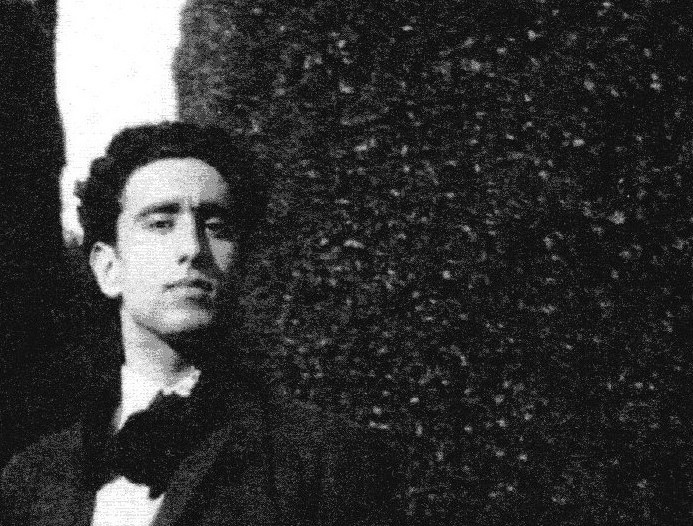
Carlo Raimondo Michelstaedter (1887 – 1910)
And yet, as long as age still permits and the necessary reserves of energy remain, the wounded ego will soon regroup, projecting new images of pleasure and self-affirmation, and will once again hurl itself, with greater vitality than before, into their pursuit:
Having passed a sleepless night pacing up and down the veranda, he decided to go to Petersburg and bestir himself, in order to punish those who had failed to appreciate him and to get transferred to another ministry.
Next day, despite many protests from his wife and her brother, he started for Petersburg with the sole object of obtaining a post with a salary of five thousand rubles a year (Tolstoy 1917:15).
Small changes here and there, successive shifts in ministries and positions, activities and interests, social circles and interactions, a constant squandering of energy but still, at its core, that same ever-thirsty petit-bourgeois ego, craving aggrandizement, expansion, and satisfaction.
Now, the god of consumption and material goods presents himself to the petty ego as its grand new opportunity for new identification and self-affirmation.
In reality it was just what is usually seen in the houses of people of moderate means who want to appear rich, and therefore succeed only in resembling others like themselves: there are damasks, dark wood, plants, rugs, and dull and polished bronzes — all the things people of a certain class have in order to resemble other people of that class. His house was so like the others that it would never have been noticed, but to him it all seemed to be quite exceptional. He was very happy when he met his family at the station and brought them to the newly furnished house all lit up, where a footman in a white tie opened the door into the hall decorated with plants, and when they went on into the drawing-room and the study uttering exclamations of delight. He conducted them everywhere, drank in their praises eagerly, and beamed with pleasure (Tolstoy 1917:17-8).
Not even for a single moment can the petty ego realize how unfathomable its pettiness truly is, precisely because it constitutes the product of a fundamental split, a rupture from a wholeness, a continuum which encompasses all other forms of living organisms, as well as inorganic matter, save this ego itself. Intuiting, however, its tragic limitation, it embarks on an endless, self-destructive battle for its own expansion and aggrandizement, until its definitive exhaustion, its ultimate collapse. Because, alas: it seeks that expansion and aggrandizement solely in images, which it goes on projecting onto itself, in a futile and sadly repetitive game of illusion and frivolity. And, it is precisely that frivolity of the ego that leads it into all kinds of identifications with persons and things, to its obsessive attachment to the always volatile object of its desire.
Mechanically pursuing its hopes, desires and goals, without ever truly being aware of its deeper motives, without ever examining whether they are genuinely real and useful or merely ideational, and hence non-existent or even dangerous, the self reaffirms its deepest nature time and again: its superficiality. And the vicious circle of the void, with all its fear and despair perpetuates itself:
It [an organism that lives in superficiality] does not live things more profoundly but affirms in them only its superficial relations, its small world. And the smaller its world, the more indifferent, easily reproducible, and transplantable it is among different things. One takes the fish with a little of the water from where it lives3 and tosses it into other water; the plant, not with naked roots but with just that much soil, and puts it in a vase; a man, with the means of subsistence, and makes of him whatever one wants. He who does not live with persuasion cannot fail to obey, for he has already obeyed. Πρὸς τὸν βίον παντοῖος γίγνεται φιλοψυχίᾳ πειθόμενος ὃστις ὁρμᾶται ἂνευ πειθοῦς, ‘reaching for life he who lives without persuasion assumes every form, obeying the fear of death.’ This, which men often call docility, goodness, or even superiority of or knowledge of the world, is none other than the superficiality of those without reason in what they do, who merely find themselves doing it, not knowing why they wanted the things they wanted, having neither the potency of those things in themselves nor the sufficiency to withstand their loss. Instead they find themselves extracting their little lives from those things. Only fear for their own continuation makes them exchange those things now, in the same way that they grasped them before, when they obeyed that fear through insufficiency (Michelstaedter 2004:34-5).
For the ego the desideratum is its ceaseless activity; the ego is the most restless – albeit ideational – entity that we know; a pause in its movement, even for the briefest fraction of time, means its immersion into the deepest despair; it could even lead to its very annihilation; and this is its greatest fear: its non-existence; ego, the self, dwells in the domain of time; precisely for this reason, the ending of time would mean completely emptying human consciousness of its content, which is none other than the ego itself; every single desire, even though it is satisfied – so to speak, because desire, by its very nature, can never be satisfied – is automatically replaced by its successor desire. And the whole process must, at all costs, continue incessantly, ad infinitum.
As soon as Ivan Ilyich and his family settled into their new, luxurious home, the mechanism of desire was set in motion again, making that characteristic sense of discontent felt once more, projecting new images of an even better life, somewhere in the future, bringing with it disappointment and anxiety:
So they began living in their new home — in which, as always happens, when they got thoroughly settled in they found they were just one room short — and with the increased income, which as always was just a little (some five hundred rubles) too little, but it was all very nice.
Things went particularly well at first, before everything was finally arranged and while something had still to be done: this thing bought, that thing ordered, another thing moved, and something else adjusted. Though there were some disputes between husband and wife, they were both so well satisfied and had so much to do that it all passed off without any serious quarrels. When nothing was left to arrange it became rather dull and something seemed to be lacking, but they were then making acquaintances, forming habits, and life was growing fuller (Tolstoy 1917:18).
Unable to realize the deeper, insatiable nature of the mechanism of desire, the ego moves from one micro-goal to another, from one useless object to the next, from one vanity to another, without even knowing why, without ever understanding the futility and meaninglessness of these goals, their incapacity to offer it the permanent pleasure and eudaemonia it seeks, driven solely by the blind impulse of desire that propels it into incessant, feverish action. An inclusive definition of the human being could very well be: ‘the animal which suffers as long as it lives’:
For man and the living creature cannot be deprived of the perfection of existence, and hence of happiness, without suffering, and without unhappiness. And between happiness and unhappiness there is no halfway state. That is the necessary, continuous, and perpetual goal of all acts, external and internal, and the whole life of the animal. Not obtaining it, the animal is unhappy; and this in each of those moments in which, desiring the said goal, that is, happiness without limit,4 as he always does, he does not obtain it and is deprived of it, as he always is. And so man can be physically certain that he will not spend, not just a day but an instant, without suffering. And all life is truly, by its own immutable nature, a fabric of necessary sufferings, and each instant that composes it is a suffering (Leopardi 2013:1488).
And the foolish, egocentric game of identifications of the splintered, severed, and derelict human animal perpetuates itself endlessly. Having gained only disenchantment and frustration from the myriad games in which it has been enmeshed – family, work, socialization – the ego becomes more and more impassive and cynical, indulging in ever more superficial and contemptible activities, in new, equally senseless and dull games: “The pleasures connected with his work were pleasures of ambition; his social pleasures were those of vanity; but Ivan Ilych’s greatest pleasure was playing bridge” (Tolstoy 1917:19).
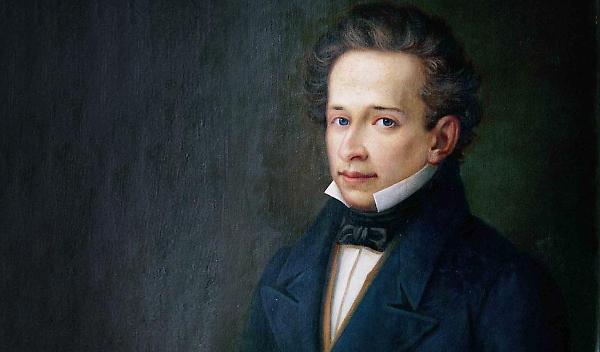
Giacomo Leopardi (1798 – 14 June 1837)
Of course, in essence, it is always the same sorrowful game: the ego cannot live if there is no hope, the object of a desire, a promise of joy and happiness, always projected into the future – be it the very next moment or a distant, indeterminate future. This is the essence of Schopenhauer’s will,5 the driving force of every living organism, including the human being – in the most profoundly tragic manner in the case of the latter – which impels it to persist in life and not choose to depart from it of its own volition.
In the indifferent haze of things the god makes 6 the one thing the organism needs shine; and the organism struggles toward it as if to satiate all its hunger, as if that thing could provide all its life: absolute persuasion. But the knowing god extinguishes the light when its abuse would remove its usefulness, and the animal, satiated only with regard to that thing, turns toward another light, which the benevolent god has shown it. And toward it the organism struggles with all its hope, until again the light is extinguished, only to be reignited at another point. . . . No sooner does the animal feel disappointed, the thread of its existence having been cut short, than the light reappears without respite like lightning on a summer night. And in that light the animal’s entire future gleams: the possibility of eating, sleeping, drinking, lying together shines in the pursuit of another animal, while in eating lies the possibility of running, resting, and so on. In this manner, flattering the animal with arguments for its own life, the wise god leads it across the obscurity of things in his luminous wake in order that the animal should continue and never be persuaded—until an obstacle puts an end to the sad game. This benevolent and prudent god is the god of philopsychia7 and the light is pleasure (Michelstaedter 2004:20).
However, a moment comes when death decisively knocks on our door. Βίος:8 τῷ οὖν τόξῳ ὂνομα βίος, ἒργον δέ θάνατος, as Heraclitus has said. In this eternal hunt of unattainable pleasure and happiness, in the midst of successive disappointments, frictions, and quarrels, framed by meager, fleeting moments of illusory bliss, there comes a moment when Ivan Ilyich falls and injures his side. What at first seems to be just a harmless blow will soon prove to be the formal beginning of his journey towards death. His wound is much more serious than he initially thought. Day by day, Ivan Ilyich is dying – and what’s more, in the most excruciating and agonizing manner imaginable. And only through his agonizing journey towards the end will Ivan Ilyich realize that his entire life has not been a life at all – in the real, tangible meaning of the term – but rather, a so-called ‘life,’ based on superficiality, petit-bourgeois mentality, and social conventions with all their hypocrisy and falsehood. In other words, a shallow life, based solely on the spurious succession of images produced by human thought. Ultimately, a life of a slave and not that of a free – and hence perhaps happy – human being.
Or perhaps it wasprecisely this distorted ‘life’ – with all its falsehood, superficiality, inhumanity, and malice, which in fact constitutes the common ground of all humanity – that was the very reason why Ivan Ilyich fell ill, first psychologically, and then biologically?
But now every mischance upset him and plunged him into despair. He would say to himself: “there now, just as I was beginning to get better and the medicine had begun to take effect, comes this accursed misfortune, or unpleasantness . . . ” And he was furious with the mishap, or with the people who were causing the unpleasantness and killing him, for he felt that this fury was killing him but he could not restrain it (Tolstoy 1917:23).
Be that as it may, regardless of the barren game of cause and effect – which, in cases like Ivan Ilyich’s, can lead nowhere but to greater confusion and despair – the fact remains that Ivan Ilyich is dying. And nobody around him cares or feels sorry for him. This is the other indisputable fact, which draws him even faster toward death:
Praskovya Fedorovna’s attitude to Ivan Ilych’s illness, as she expressed it both to others and to him, was that it was his own fault and was another of the annoyances he caused her.
At the law courts too, Ivan Ilych noticed, or thought he noticed, a strange attitude towards himself. It sometimes seemed to him that people were watching him inquisitively as a man whose place might soon be vacant. Then again, his friends would suddenly begin to chaff him in a friendly way about his low spirits, as if the awful, horrible, and unheard-of thing that was going on within him, incessantly gnawing at him and irresistibly drawing him away, was a very agreeable subject for jests. Schwartz in particular irritated him by his jocularity, vivacity, and savoir-faire, which reminded him of what he himself had been ten years ago (Tolstoy 1917:24-5).
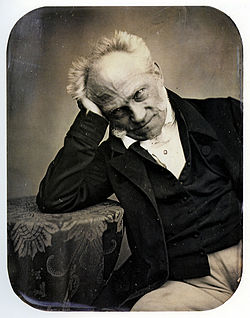
Arthur Schopenhauer (1788 – 1860)
And no false faith, no superstition whatsoever is going to help him ignore the relentless fact before which he has suddenly found himself:
One day a lady acquaintance mentioned a cure effected by a wonderworking icon. Ivan Ilych caught himself listening attentively and beginning to believe that it had occurred. This incident alarmed him. “Has my mind really weakened to such an extent?” he asked himself. “Nonsense! It’s all rubbish. I mustn’t give way to nervous fears but having chosen a doctor must keep strictly to his treatment (Tolstoy 1917:24).
Nor, of course, can the unbridled delirium of thought – the most common drug humans use to shield themselves from reality – help him. On the contrary, it has been one of the reasons – perhaps the most important – why he remained trapped on the surface of things throughout his life, unable to face any fact directly, without distortion, and to comprehend it in all its depth:
And to replace that thought he called up a succession of others, hoping to find in them some support. He tried to get back into the former current of thoughts that had once screened the thought of death from him. But strange to say, all that had formerly shut off, hidden, and destroyed his consciousness of death, no longer had that effect (Tolstoy 1917:30).
Even the most powerful smokescreen that thought constructs to evade the dreadful idea of death – recollecting one’s childhood – no longer works. Nothing can conceal the awareness of imminent death, which is already ante portas.
The syllogism he had learnt from Kiesewetter’s Logic: “Caius9 is a man, men are mortal, therefore Caius is mortal,” had always seemed to him correct as applied to Caius, but certainly not as applied to himself. That Caius — man in the abstract — was mortal, was perfectly correct, but he was not Caius, not an abstract man, but a creature quite, quite separate from all others. He had been little Vanya, with a mamma and a papa, with Mitya and Volodya, with the toys, a coachman and a nurse, afterwards with Katenka and will all the joys, griefs, and delights of childhood, boyhood, and youth. What did Caius know of the smell of that striped leather ball Vanya had been so fond of? Had Caius kissed his mother’s hand like that, and did the silk of her dress rustle so for Caius? Had he rioted like that at school when the pastry was bad? Had Caius been in love like that? Could Caius preside at a session as he did? “Caius really was mortal, and it was right for him to die; but for me, little Vanya, Ivan Ilych, with all my thoughts and emotions, it’s altogether a different matter. It cannot be that I ought to die. That would be too terrible” (Tolstoy 1917:30).
Even less could his job – to which he dedicated the greater part of his life and in which he placed most of his hopes while he was still healthy – provide him, at this final moment, with the ‘screen’ he desperately needs to hide from death:
He would shake himself, try to pull himself together, manage somehow to bring the sitting to a close, and return home with the sorrowful consciousness that his judicial labours could not as formerly hide from him what he wanted them to hide, and could not deliver him fromIt10 (Tolstoy 1917:31).
And likewise, none of the other ‘screens’ he relied on throughout his life is capable of saving him from imminent death:
And to save himself from this condition Ivan Ilych looked for consolations – new screens11 –and new screens were found and for a while seemed to save him, but then they immediately fell to pieces or rather became transparent, as if It penetrated them and nothing could veil It (Tolstoy 1917:31).
And yet, it might well have been all those ‘screens’ behind which he sought to hide throughout his life that ultimately hid him from life itself, while at the same time giving him the false impression that they had hidden death from him once and for all:
In these latter days he would go into the drawing-room he had arranged – that drawing room where he had fallen and for the sake of which (how bitterly ridiculous it seemed) he had sacrificed his life – for he knew that his illness originated with that knock. He would enter and see that something had scratched the polished table (Tolstoy 1917:31).
Ivan Ilyich, like every other human being, unknowingly sought to acquire an identity, an ego, a life of his own. However, he looked for it in things and ideas, and through this fetishistic stance towards life, he ultimately lost both himself and his life, while at the same time, without realizing it, he persistently invited death at every moment:
But man wants from other things in a future time what he lacks in himself: the possession of his own self,12 and as he wants and is busied so with the future he escapes himself in every present. Thus does he move differently from the things different from him, as he is different from his own self, continuing in time. What he wants is given within him, and wanting life he distances himself from himself: he does not know what he wants. His end is not his end, nor does he know why he does what he does: his activity is being passive, for he does not have himself as long as an irreducible, obscure hunger for life lives within him. Persuasion lives not in him who does not live from his own self,who is son and father, slave and master of what lies around him, of what came before, of what must come after— a thing among things (Michelstaedter 2004:11).
In the final analysis, painful as it might be, Ivan Ilyich will begin to realize that our only option in the face of death is perhaps to confront it for exactly what it is: a fact. Any attempt to escape it using the cheap and childish tools of our thinking is futile and only deepens the pain of loss and the inevitability of the end: memories, reminiscences, nostalgic wanderings through a distant past, new identifications and attachments, self-pity, conscious efforts to divert thought toward pleasant distractions – any attempt to evade our ultimate confrontation with death is doomed to fail from the outset. In the end, every dying person finds himself once again face-to-face with the one who has been watching him incessantly, with both admirable and exasperating attentiveness, for as long as he can remember: the observer; “It”:
“It really is so! I lost my life over that curtain as I might have done when storming a fort. Is that possible? How terrible and how stupid. It can’t be true! It can’t, but it is.” He would go to his study, lie down, and again be alone with It: face to face with It. And nothing could be done with It except to look at it and shudder (Tolstoy 1917:31-2).
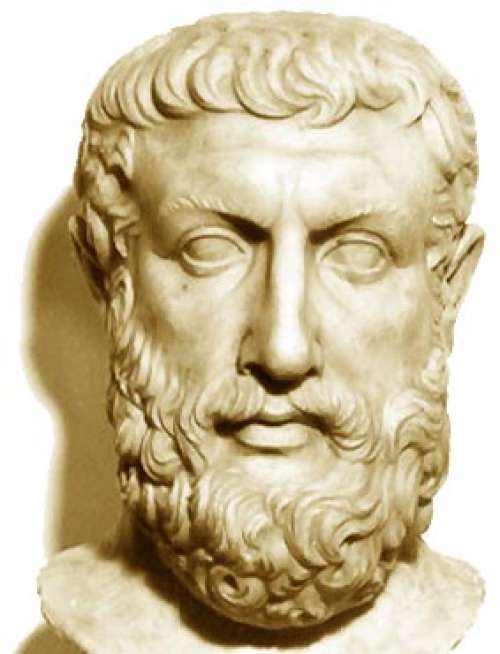
Heraclitus
However, the bareness of the observer in the face of death is not the only excruciating torment during one’s final moments; not even death itself. Perhaps the most harrowing one is the falsehood of one’s life: the rabid persistence of one’s persona until the very end; specifically, the persona of the dying one:
Ivan Ilych wanted to weep, wanted to be petted and cried over, and then his colleague Shebek would come, and instead of weeping and being petted, Ivan Ilych would assume a serious, severe, and profound air, and by force of habit would express his opinion on a decision of the Court of Cassation and would stubbornly insist on that view. This falsity around him and within him did more than anything else to poison his last days (Tolstoy 1917:35-6),
as well as of anybody else around him:
Her attitude towards him and his diseases is still the same. Just as the doctor had adopted a certain relation to his patient which he could not abandon, so had she formed one towards him — that he was not doing something he ought to do and was himself to blame, and that she reproached him lovingly for this — and she could not now change that attitude (Tolstoy 1917:39).
Every persona is created by our thirst for knowledge, when in reality we don’t know absolutely nothing, that is precisely why we are afraid:
“Certainly. But one must be conscious of doing one’s duty. That much is certain. On duty one doesn’t compromise. It’s one thing to get satisfaction from literature, science, art, and philosophy in pleasant conversations—but serious life is something else. You could say: theory is one thing, practice another! For myself, as you see, I get satisfaction from these theoretical discussions and take real pleasure in elegant ethical problems, and even allow myself the luxury of exchanging some paradoxical propositions. But don’t mistake – everything in its time and place. When I wear the uniform, I wear another persona.13 I believe that in the exercise of his functions man must be absolutely free. Free in mind and spirit. In the antechamber of my office I leave all my personal opinions, feelings, human weaknesses. And I enter the temple of civilization to accomplish my work with a heart tempered by objectivity! Then I feel I’m bringing my contribution to the great work of civilization for the good of humanity. And the holy institutions speak through me. Am I right, eh?” (Michelstaedter 2004:105).
But even this persona, this human mask, this lie, this illusion – in sum, the entire construct of the self – will be taken by death. And there is no ruse, no force capable of undoing this simple but inexorable fact. And yet, it is to this persona that we cling, with all the strength that we possess, throughout our lives. Why? This is the only model of life that we know; it is what we are taught to follow. What’s more: it is imposed upon us from the very beginning. What is the purpose of all this, if, in the end, death – indeed, an excruciating death – is the ineluctable fate that awaits us all?
“If I could only understand what it is all for! But that too is impossible. An explanation would be possible if it could be said that I have not lived as I ought to. But it is impossible to say that,” and he remembered all the legality, correctitude, and propriety of his life. “That at any rate can certainly not be admitted,” he thought, and his lips smiled ironically as if someone could see that smile and be taken in by it. “There is no explanation! Agony, death. . . . What for?” (Tolstoy 1917:47).
In the last analysis, if there is any answer at all, it may be found at the beginning, not the end. When one embarks on the paradoxical journey of life, not just moments before being forced to leave it. And what if one has not done what was right when he ought to have? If he was unable to recognize in time what that right was? And isn’t there, even now, at this final moment, an action that could erase all the mistakes of the past, wipe away the entire false persona with which one has lived, so that one might reclaim at last the possession of one’s self in the here and now, the persuasion which does not depend on and is not affected by anybody or anything, even if it were for a sole moment, or for the few moments of life one still has?
“How good and how simple!” he thought. “And the pain?” he asked himself. “What has become of it? Where are you, pain?” He turned his attention to it. “Yes, here it is. Well, what of it? Let the pain be.” “And death . . . where is it?” He sought his former accustomed fear of death and did not find it. “Where is it? What death?” There was no fear because there was no death. In place of death there was light. “So that’s what it is!” he suddenly exclaimed aloud. “What joy!” To him all this happened in a single instant, and the meaning of that instant did not change. For those present his agony continued for another two hours. Something rattled in his throat, his emaciated body twitched, then the gasping and rattle became less and less frequent. “It is finished!” said someone near him. He heard these words and repeated them in his soul. “Death is finished,” he said to himself. “It is no more!” He drew in a breath, stopped in the midst of a sigh, stretched out, and died (Tolstoy 1917:52).
There is death, something you do not know. What you don’t know you are afraid of – at least you think you are afraid of something you do not know. But is that so? How can you be frightened of something you do not know? You are frightened of losing something you already know – that is the real cause of fear. Not the unknown but something which you have stored up – of losing that you are afraid. You are afraid of losing the known, not of the unknown.
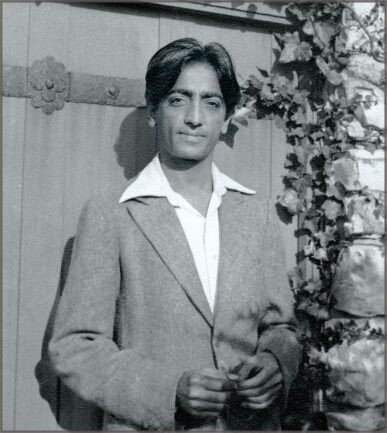
Jiddu Krishnamurti
From Public Talk 7, New Delhi, 11 February 1962
***
Jiddu Krishnamurti (1895 – 1986)
Notes
1 Unless otherwise stated, emphasis is added by the author.
5 “Therefore the striving of matter can always be impeded only, never fulfilled or satisfied. But this is precisely the case with the striving of all the will’s phenomena. Every attained end is at the same time the beginning of a new course, and so on ad infinitum” (Schopenhauer 2015:Vol. 1, p. 164).
8 In English: The name of the bow is life, but its work is death (Heraclitus 1889:100, 128). Here, Heraclitus employs a wordplay: in ancient Greek, the word βιός meant bow, whereas the phonetically similar βίος meant life. The only difference between the two Greek words (βιός and βίος) lies in the placement of the accent.
9 At this point, Tolstoy refers to a well-known syllogism found in an enchiridion of Logic written by the German Kantian philosopher Johann Gottfried Kiesewetter (1766-1819): “Caius is a man, men are mortal, therefore Caius is mortal” (here, “Caius” refers to Gaius Julius Caesar) (my note).
Bataille, G. 1992, Theory of religion, trans. R. Hurley, Zone Books, New York. (Original work published 1948).
Heraclitus 1889, The fragments of the work of Heraclitus of Ephesus: On nature, trans. G. T. W. Patrick, from the Greek text of E. H. G. Bywater, N. Murray, Baltimore.
Leopardi, G. 2013, Zibaldone, trans. K. Baldwin, R. Dixon, D. Gibbons, A. Goldstein, G. Slowey, M. Thom & P. Williams, Farrar, Straus and Giroux, New York. Kindle Edition. (Original work written 1817–1832).
Michelstaedter, C. 2004, Persuasion and rhetoric, trans. unknown, Yale University Press, New Haven. (Original work published 1909).
Schopenhauer, A. 2005, Essay on the freedom of the will, trans. K. Kolenda, Dover Publications, Inc., New York. Kindle Edition. (Original work published 1838).
Schopenhauer, A. 2015, The world as will and representation, vol. 1, trans. E. F. J. Payne, Dover Publications, Inc. (Original work published 1818–1819, 1844).
Tolstoy, L. N. 1917, The death of Ivan Ilyich, trans. L. & A. Maude, Tolstoy Library, retrieved from. (Original work published 1886).
 Katoptron